
Cases
Reading the CS2 Case Rotation in 2026
Valve's CS2 active case rotation has shifted hard since 2024. Here's the current state of farmable cases, what got retired, and what the rotation does to pricing.
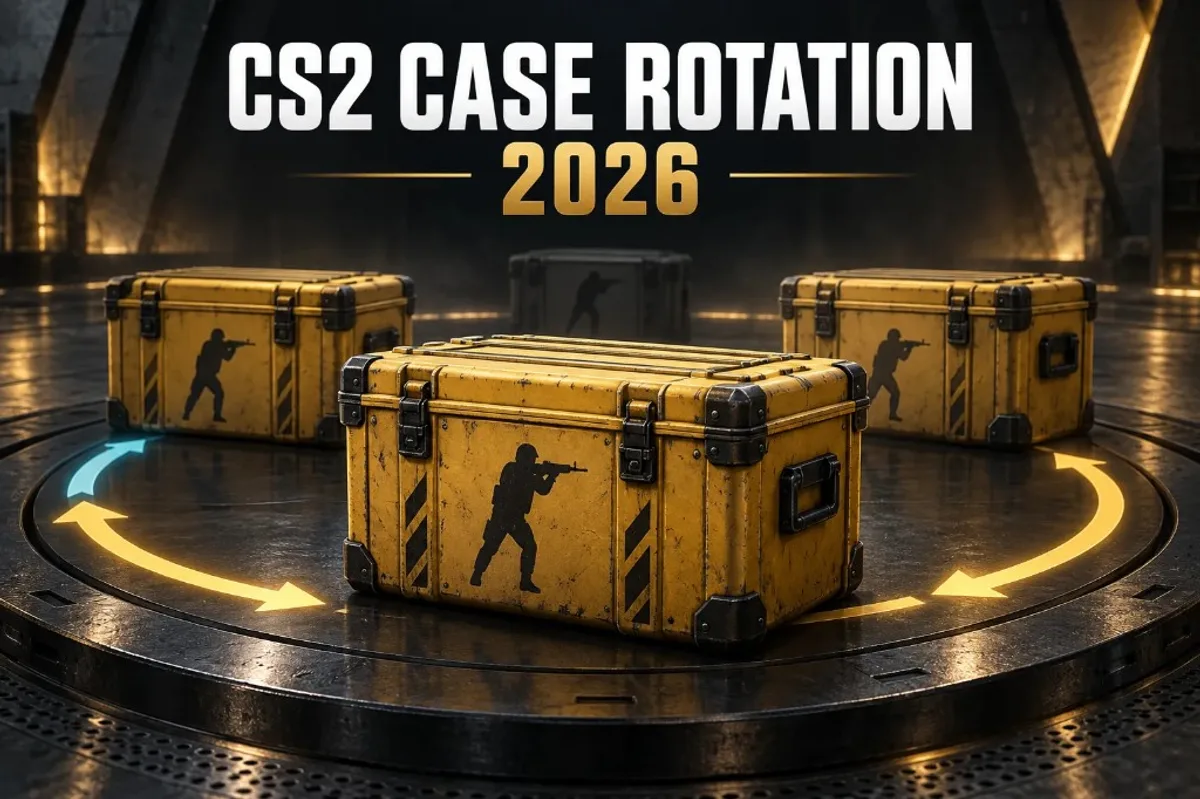
Valve doesn’t publish a CS2 case rotation list. Instead, the active list lives entirely inside the in-game drop system. Players find out which cases drop by playing. Third-party trackers watch the public Steam Market supply and infer the rotation from sudden inventory inflows. This guide walks through how to read the rotation in 2026 and why it matters for opening decisions.
Active vs retired vs discontinued
Cases live in three buckets:
- Active: drop in-game from competitive matches. Their Steam Market supply grows daily as players sell their drops.
- Retired: no longer drop, but still openable and tradable. Their supply is fixed.
- Discontinued: same as retired in practice — Valve doesn’t formally use the word “discontinued” in CS2 — but the term is sometimes used for very old cases whose key is no longer purchasable directly from Valve. (As of 2026, all CS2 case keys remain purchasable, so this category is mostly empty.)
How rotation moves prices
A case’s Steam Market price is a function of supply and key-demand. While a case is active, the supply is growing, which tends to push the market price down toward the floor of “what someone will pay to get the keys’ worth out of it.” The moment a case retires, that supply growth stops, and the market starts pricing the case as a finite-supply asset.
For 2026, the practical implication is: active cases with attractive knives often trade at or near their floor, while retired cases with attractive knives often trade meaningfully above their nominal “expected value per key” because the market is pricing in finite supply.
What’s active now
CSGO Top doesn’t maintain a real-time active list (we don’t have access to live drop telemetry). Our case guides are written against the rotation as it stood at the time of writing, with explicit “last verified” dates on each entry. If you’re making a purchasing decision, always verify the current active list yourself by playing a few matches and noting what drops. This is the only authoritative source.
How we approach case ranking on CSGO Top
Our /cases/ ranking pages are organized by editorial intent:
- Best CS2 cases for collectors — long-term-supply cases with strong knife sets.
- Best CS2 cases for opening — active or recently-retired cases with the most reasonable expected value per key.
- Best CS2 cases on a budget — low-key-cost cases where the variance is more entertaining than punishing.
We don’t claim any case is “+EV per key.” Most aren’t. We do claim that some cases are noticeably less −EV than others, which is the meaningful comparison for anyone opening cases as a paid form of entertainment.